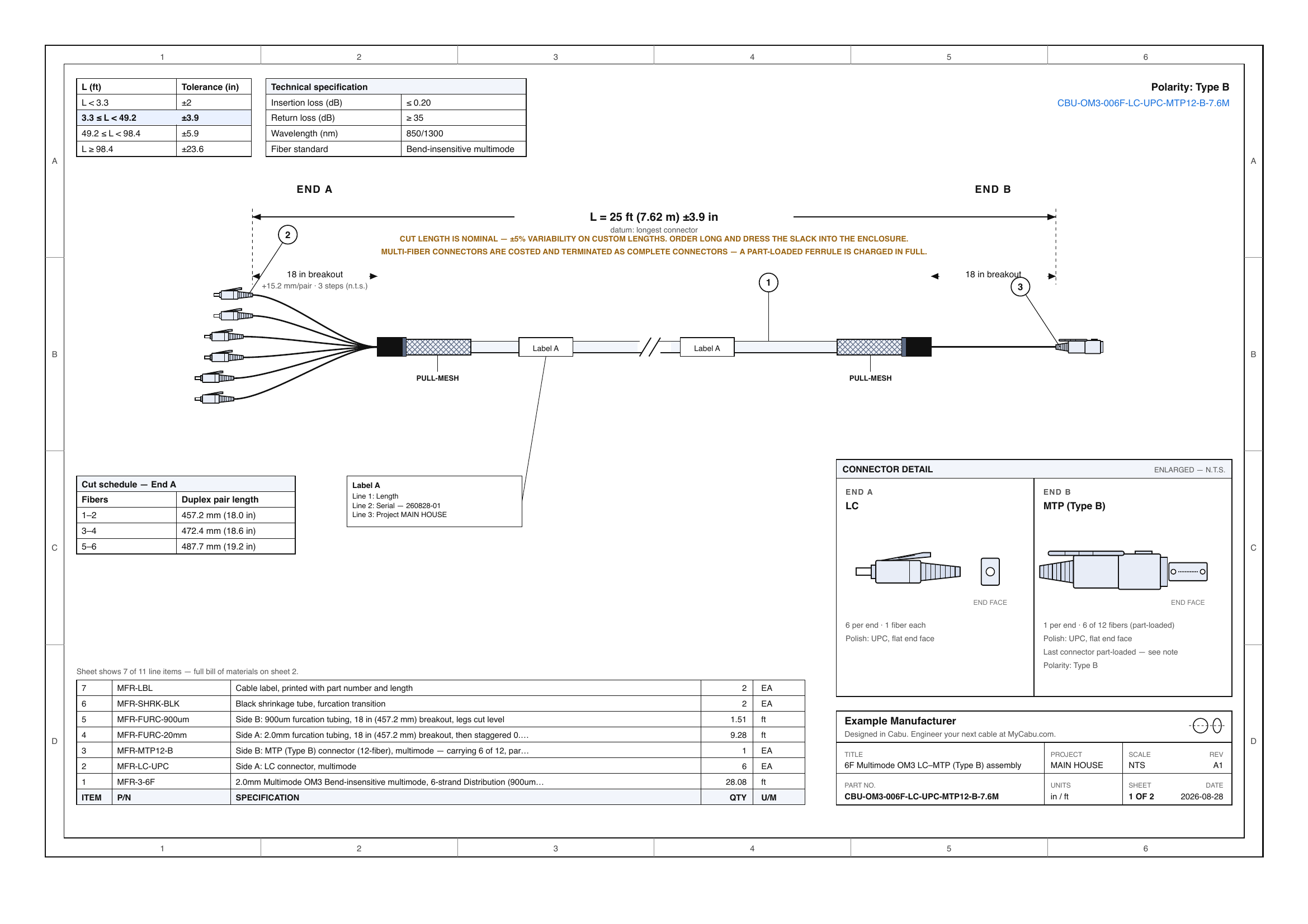
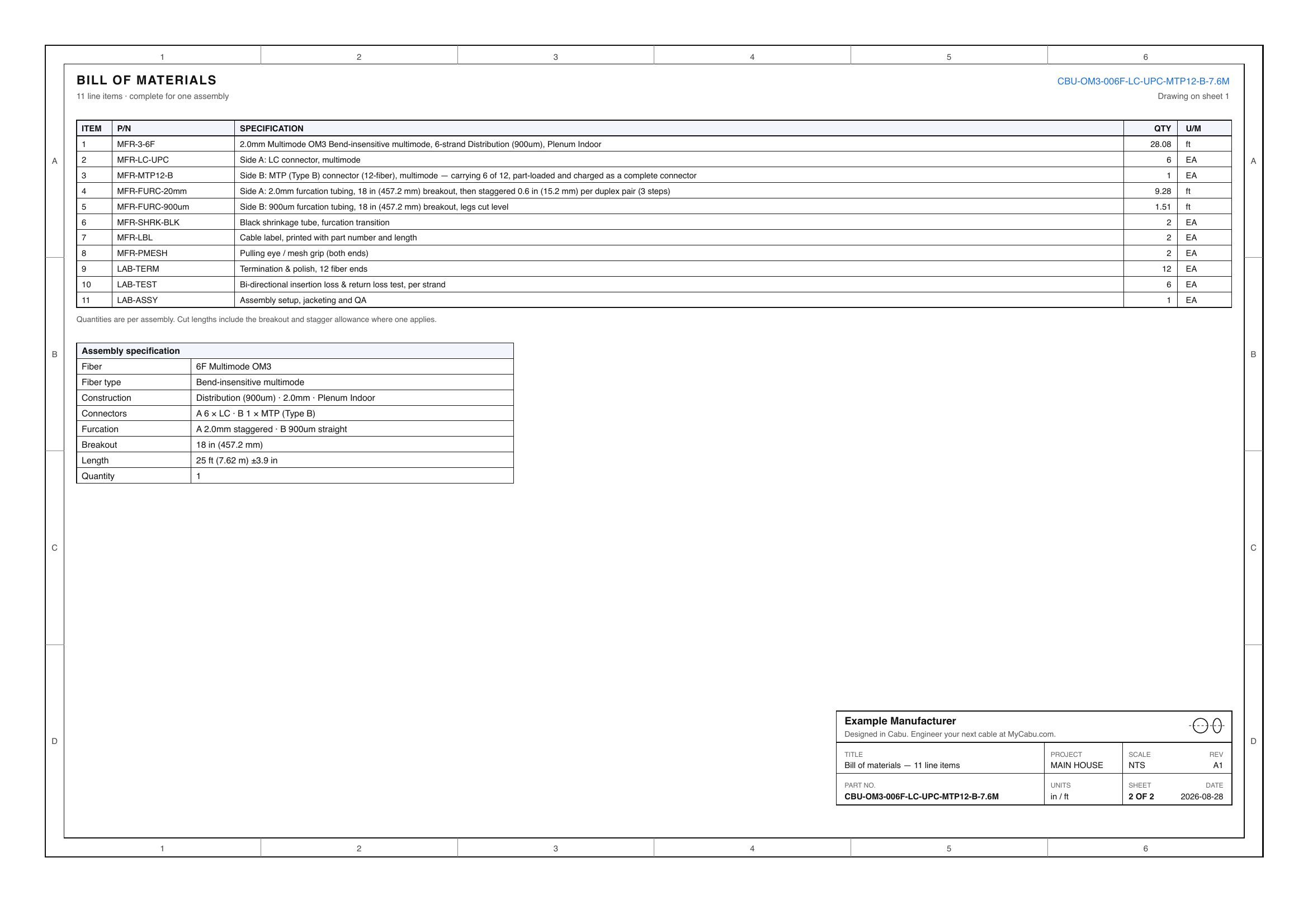
Specify the assembly you actually need and Cabu returns a full engineering drawing, a bill of materials and a cut schedule — computed from your configuration, on screen, while you are still typing.
Free to use · no card, no minimum order
A cable nobody stocks still has to be drawn, priced and built by someone — and today that someone is a chain of phone calls.
Discretionary cable is the just-in-time end of the market: the custom assemblies that get bought on demand to finish a project or service an install. There is no catalog number for a 12-fiber trunk with LC on one end, MTP on the other and a staggered breakout.
So it goes customer → distributor → manufacturer, someone draws it by hand, and a quote works its way back up the chain. Days pass. Drawings get retyped. A breakout length gets transposed and the assembly arrives short — and a cable cut short cannot be lengthened.
Cabu collapses that into one step. You specify it, Cabu draws it.
Every output is computed from the typed configuration by fixed rules. Nothing on the sheet is written by a language model, and nothing waits on a human.
A dimensioned, zone-bordered sheet with a title block — connector geometry, tolerance band, environment call-outs and the cut schedule the bench actually works to. Hybrids are issued as a three-sheet set, because fiber and copper are tested in completely different ways and cannot share one sheet.
Every line derived from your selections — connector counts follow the fiber-per-connector rule, furcation legs follow the manufacturer's standard breakout, and the copper pin map falls out of the wiring standard rather than being typed by hand.
A built-in glossary on every field. What Micro-Armor is, why plenum matters, what a staggered breakout is for. Written and versioned by people who build this cable — not generated — because an installer acts on what it says.
Four steps, no callback.
Fiber, copper, or both under one jacket.
Grade, construction, strand or pair count, jacket rating, armor, connectors and boots on each end.
The sheet, the bill of materials and the cut schedule recompute on every change.
Keep every cable you design, and send one to the manufacturer when you're ready.
The engine is deterministic. Three examples of what that means in practice.
Nothing. The designer is free to use — you need an account so your designs are saved against you, and that's the whole of it. No card, no minimum order.
No. Every field has a plain-English explanation behind it, and the rules that govern connector counts, leg lengths and pin maps are applied for you. If a build won't carry the link — a Cat6 run past 100 m, say — Cabu says so on screen and on the sheet.
Your designs are private drafts. Nobody else sees one until you choose to send it to the manufacturer, and then they see the build, your name and your company — the things they need to quote it.
Yes. The cable you design is yours, and you can download and use the drawing however you like.
Not one number on a drawing. The whole engine is deterministic — the same configuration always produces the same sheet, bill of materials and cut schedule. The glossary is hand-written and versioned for the same reason: someone builds from what it says.
Cabu is in closed beta with a small group of manufacturers and their customers. If you were sent an access code, it works on the sign-up form.